
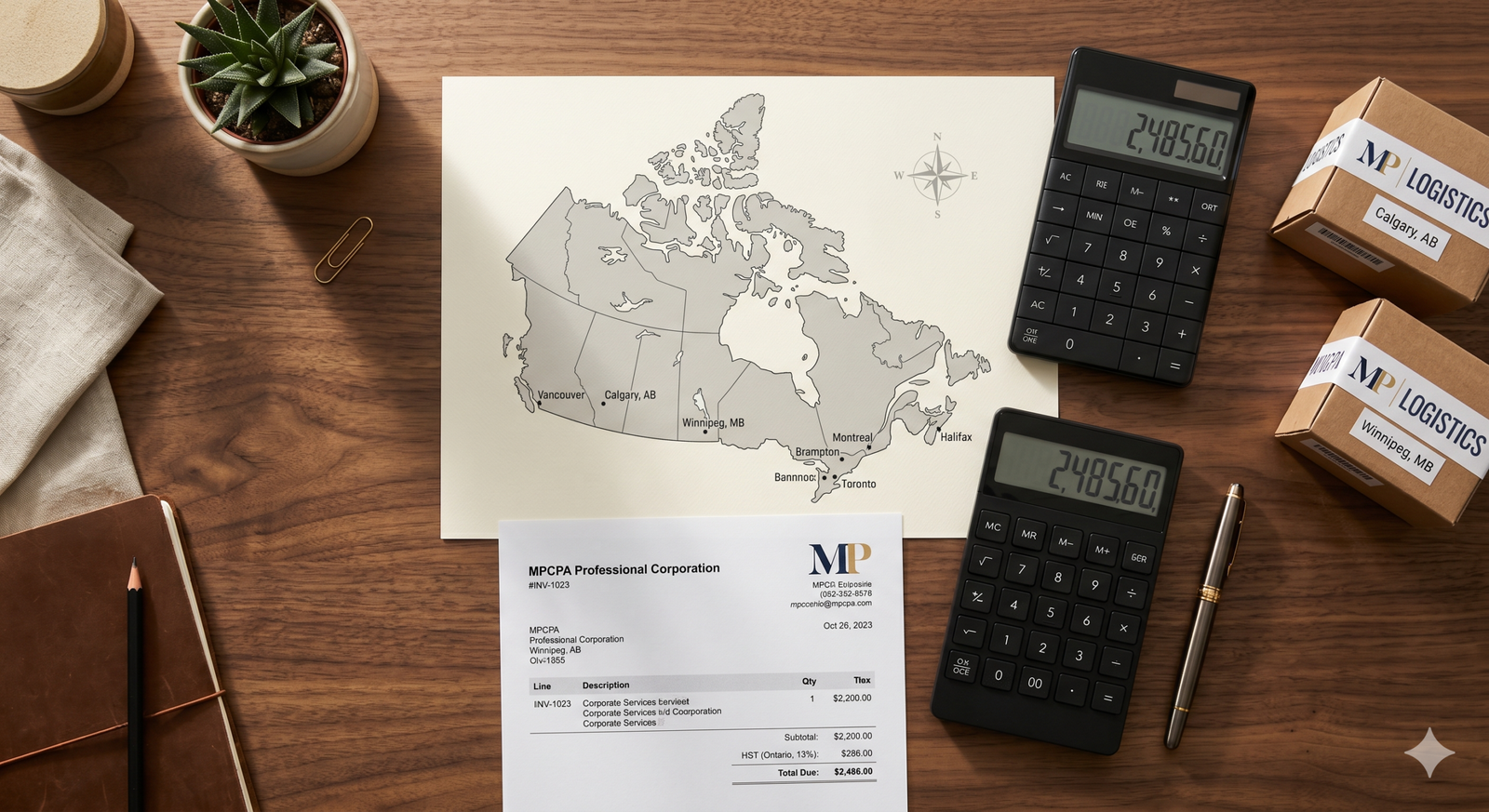
For growing corporations in Brampton, scaling operations across Canada is a massive milestone. Whether you are an e-commerce brand shipping physical goods to British Columbia or a B2B manufacturer supplying parts to Alberta, expanding your footprint means expanding your revenue. However, it also introduces one of the most common—and costly—corporate compliance traps: the CRA’s “Place of Supply” rules.
Thank you for reading this post, don't forget to subscribe!Many Ontario-based business owners mistakenly assume that because their corporation is registered and headquartered in Brampton, they simply apply Ontario’s 13% Harmonized Sales Tax (HST) to every invoice they generate. Unfortunately, the CRA does not see it that way. Applying the wrong tax rate across provincial lines can lead to massive corporate tax liabilities, frustrated clients, and triggering a costly CRA audit.
The Golden Rule: Destination Dictates the Tax
In Canadian corporate tax, the “Place of Supply” rule dictates that the applicable sales tax is based on where the product or service is delivered, not where your business is located. If your Brampton corporation sells a skid of materials and ships it to a client in another province, ownership is technically transferring in that destination province. Therefore, you must apply the tax rates of that specific jurisdiction.
Navigating the Three Tax Zones
When your corporation invoices a domestic client outside of Ontario, you are generally dealing with three different scenarios:
- Participating Provinces (The HST Zone): If you ship goods to provinces that have harmonized their taxes with the federal government, you charge their specific HST rate. For example, shipping to New Brunswick or Newfoundland means charging 15% HST. Notably, as of April 2025, Nova Scotia reduced its rate, meaning corporate invoices to NS should reflect 14% HST.
- The GST-Only Provinces: If you ship goods to Alberta or the Territories, the math is incredibly favorable for your clients. You drop the provincial portion entirely and only charge the federal 5% Goods and Services Tax (GST).
- The Complex Provinces (GST + PST/QST): This is where corporate accounting often breaks down. If you ship to British Columbia, Saskatchewan, Manitoba, or Quebec, you charge the 5% federal GST. However, depending on your corporate sales volume into those specific provinces, you may also be legally required to register for, collect, and remit their local provincial taxes (PST, RST, or QST).
Why Corporate Accounting Systems Fail
The biggest risk for established SMEs is automation gone wrong. If your corporate bookkeeping software (like QuickBooks or Xero) is hardcoded to apply 13% to all outgoing invoices, you are either overcharging clients in Alberta (which damages business relationships) or undercharging clients in the Maritimes (leaving your corporation on the hook to pay the difference to the CRA out of your own profit margins).
Furthermore, if your corporation meets the registration thresholds in provinces like BC or Quebec and fails to collect PST/QST, the penalties can be severe.
Protecting Your Corporation
Before you scale your shipping or sign contracts with out-of-province vendors, your invoicing architecture needs a thorough review. Your accounting systems must be capable of recognizing out-of-province addresses and automatically adjusting the tax codes.
At MPCPA, we help established Brampton businesses structure their accounting systems to ensure seamless inter-provincial compliance. Don’t let your growth become a liability. Contact our corporate tax team today at (905) 246 – 1267 to ensure your invoicing is audit-proof.